Every trading company eventually faces the same fork: build the technology in-house, or buy a SaaS product and live within its limits. Both defaults are wrong for most firms. Building from zero burns years and capital before you have a business; pure SaaS gets you live fast but caps you at whatever the vendor decided everyone needs. The firms that win pick a third path.
Two Bad Defaults
The build-versus-buy debate is usually framed as binary, and that framing is the problem. "Build" promises control and delivers a multi-year engineering project before you’ve onboarded a single trader. "Buy" promises speed and delivers a ceiling: the moment your business needs something the platform wasn’t designed for, you’re stuck filing feature requests behind everyone else.
The Cost of Building From Zero
Building your own stack means recreating years of solved problems (CRM, rule engines, payments, risk, reporting) before you reach the parts that actually differentiate you. Most of that work is undifferentiated heavy lifting: necessary, but not where your edge lives. Worse, you own it forever: every regulation, every platform integration, every scaling problem becomes your engineering team’s problem, indefinitely.
The Limits of Pure SaaS
SaaS solves the speed problem and creates a fit problem. A one-size product is, by definition, designed for the average customer, and a trading business with a real edge is not average. The specific challenge model, the unusual payout logic, the integration with a niche platform, the reporting your partners demand: these are exactly the things a generic SaaS can’t prioritize for you. You end up bending your business to fit the software.
"Most trading companies don’t need to build a platform, and they don’t need to be trapped by one either. They need a mature core they didn’t have to build, plus engineers who can shape it around the two or three things that actually make them different. That combination is the whole game."
Stasys BrilisChief Business Officer · QTG
The Hybrid Model
The model that fits most trading businesses: start on a proven platform so you’re live in weeks, not years, then put a dedicated engineering team on your specific requirements, building directly on that same core. You skip the undifferentiated heavy lifting and still get custom where it counts. No parallel stack, no feature-request queue, no rebuilding payments for the fifth time.
How to Structure It
The arrangement works when three things are true: the platform is genuinely mature (you’re not co-developing someone’s MVP), the dedicated team actually knows that platform (so they extend it instead of fighting it), and everything they build lives on the shared core (so it benefits from every future platform improvement instead of drifting into a fork). Get those right and you have the speed of buying with the control of building, without the downside of either.
Don’t build from zero, and don’t accept a SaaS ceiling. The model that fits trading businesses is a mature platform you didn’t have to build, plus a dedicated engineering team that customizes it on the same core. Speed where it’s undifferentiated, control where your edge lives.

Stasys is Chief Business Officer at Quant Technology Group, leading commercial strategy, partnerships, and international growth. He writes about how trading businesses scale operations and make build-versus-buy decisions.
More from Stasys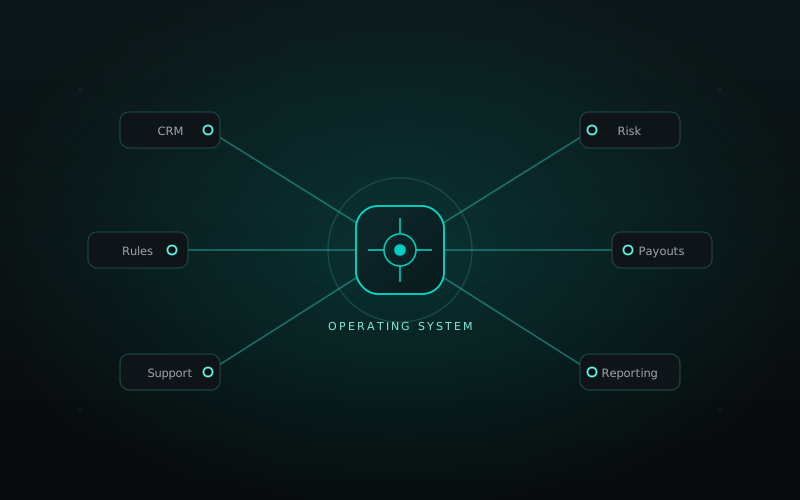
 Martin Yi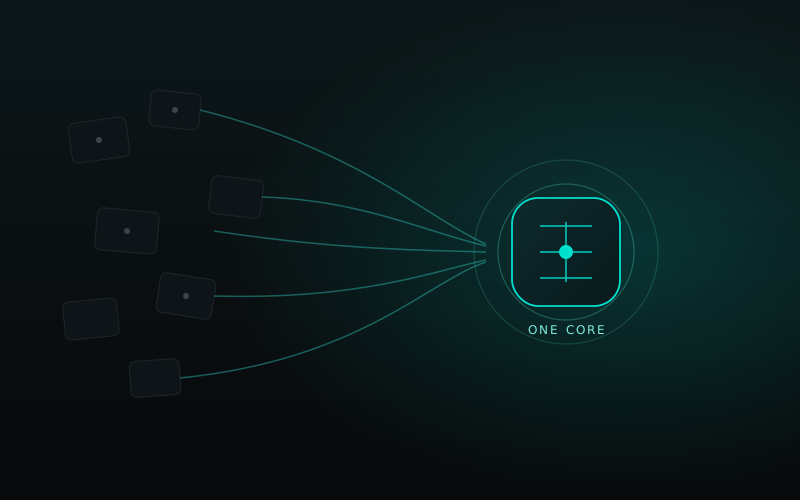
 Leonard Breitkopf
 Milos Mosovsky