Almost no trading business sets out to build a fragmented stack. It happens one reasonable decision at a time: a CRM here, a payments tool there, a risk spreadsheet a contractor wrote two years ago. Each choice made sense in isolation. Together they become the single biggest thing holding the firm back.
The Accidental Stack
A growing prop firm or broker typically ends up running five to ten disconnected systems: a CRM for onboarding, a separate tool for challenges and evaluations, a payment provider, a bridge to the trading platform, a reporting layer cobbled from exports, and, almost always, a wall of spreadsheets holding the parts nothing else covers. None of them were designed to talk to each other, so the firm’s own people become the integration layer.
For a while this works. At a few hundred accounts, a capable operations team can move data between systems by hand and keep the picture roughly accurate. The problem is that this model scales linearly with headcount and breaks non-linearly with volume. The cost doesn’t show up as a line item. It shows up as slowness, errors, and risk you can’t see.
The Silent Tax
Fragmentation charges interest every single day, in four currencies:
- 01Time: operators spend hours reconciling exports and re-keying data between systems that should share it automatically.
- 02Errors: every manual handoff is a place for a payout to go to the wrong account, a rule to be applied inconsistently, or a number to drift.
- 03Blind spots: risk lives in one system, payments in another, behavior in a third. The signal that matters is the one no single tool can see.
- 04Speed: every new product, region, or platform means another integration to hand-build, so the business moves at the pace of its slowest connection.
"The firms that plateau aren’t short on ambition or capital. They’re spending it servicing the gaps between their tools instead of growing. Fragmentation is a tax you pay in headcount, and it gets more expensive exactly when you can least afford it, during growth."
Leonard BreitkopfChief Technology Officer · QTG
Where It Breaks
There is a predictable ceiling. Somewhere between a few thousand and tens of thousands of accounts, the manual model stops bending and starts breaking. Support backlogs grow faster than the team can hire. Payout review becomes a bottleneck. Risk decisions lag the trading that triggered them. Month-end reporting takes a week because the numbers have to be assembled by hand from systems that disagree with each other.
The tell is when the answer to "why is this slow?" is always "because someone has to move it from X to Y." That sentence is the sound of infrastructure that has been outgrown.
What Consolidation Actually Looks Like
Consolidation is not "buy one big suite and rip everything out on a Friday." Done well, it is the deliberate replacement of hand-built connections with a single source of truth that every function reads from and writes to. In practice that means:
One Core, Compounding
The deeper payoff of consolidation isn’t just fewer tools. It’s that every part of the business starts making the others smarter. When risk, payouts, CRM, and reporting share one core, a signal caught in one place is instantly useful everywhere. The data stops being something you assemble and starts being something you act on. That is the difference between infrastructure that taxes growth and infrastructure that compounds it.
Fragmented infrastructure is a tax that grows with you and comes due during scaling. The fix isn’t another point tool. It’s a single connected core where data lives once and every function works from it. Firms that consolidate stop paying the integration tax and start compounding their data instead.

Leonard is Chief Technology Officer at Quant Technology Group, where he leads platform architecture and the engineering behind QTG’s risk, CRM, and infrastructure products. He writes about what it takes to build trading technology that scales from hundreds to tens of thousands of accounts without breaking.
More from Leonard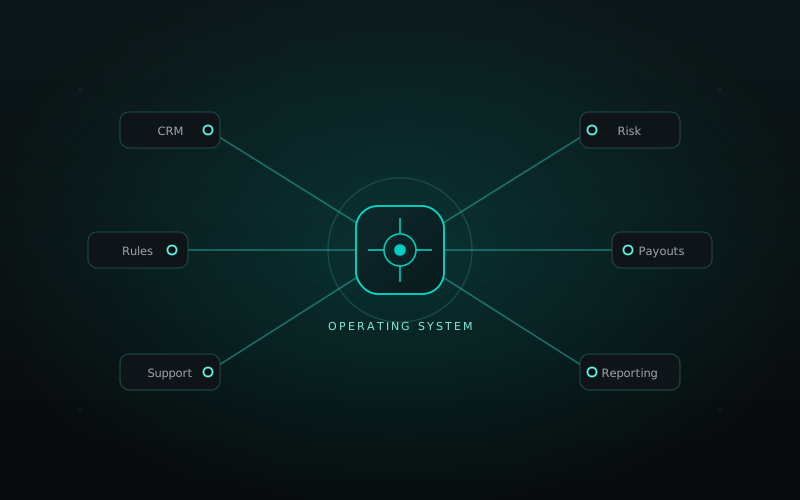
 Martin Yi

 QTG Press