Most prop firms start the same way: a CRM, a payment processor, and a small team willing to do the rest by hand. It’s a reasonable beginning. The problem is that a CRM was never designed to run a prop firm. It was designed to track relationships. The day-to-day reality of a funded-trader business lives almost entirely outside it.
The CRM Trap
A CRM is excellent at one job: knowing who your customers are and where they are in a sales pipeline. But a prop firm’s actual operations are a sequence of events the CRM can’t see: a trader passes an evaluation, breaches a drawdown rule, requests a payout, gets flagged for suspicious activity. Each of those is a decision with money attached, and in a CRM-centric firm, a human has to make every one by reading data out of one system and acting in another.
That works at small volume. It quietly breaks at scale, not because the team is bad, but because the model is manual by design. The CRM becomes a system of record for a business it can’t actually operate.
CRM vs Operating System
The distinction is simple but decisive. A CRM records. An operating system runs. A CRM stores that a trader exists; an operating system enforces the rules that govern that trader’s account, processes the payout when they earn it, and flags the behavior when something’s wrong: automatically, consistently, every time.
"The question isn’t ‘which CRM should we buy?’ It’s ‘what actually runs when a trader passes, breaches, or requests a payout?’ If the answer is ‘a person, manually,’ you don’t have an operating system yet, and that’s the thing that breaks first when you grow."
Martin YiVP Development · QTG
The Four Systems a Prop Firm Actually Runs On
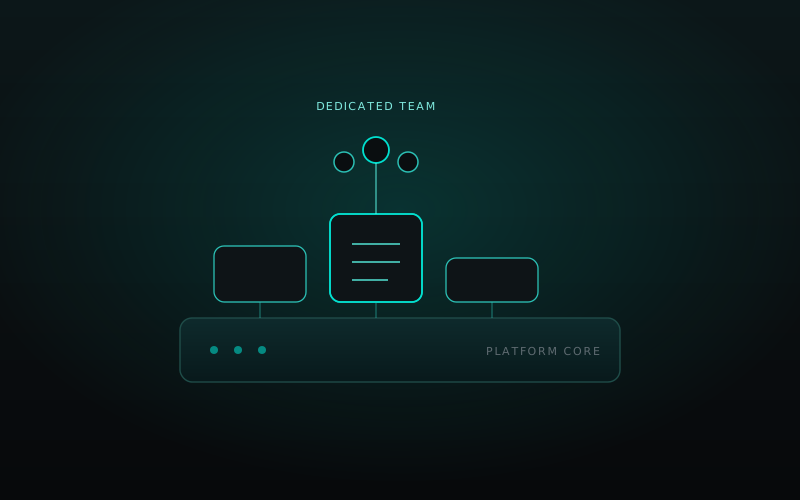
Underneath the CRM layer, a prop firm is really four connected systems working in concert. Miss any one and you’re back to doing it by hand:
Scaling Without Losing Control
The promise of an operating system isn’t just less manual work. It’s that growth stops degrading quality. In a manual firm, every new cohort of traders stretches the same team thinner, so enforcement gets less consistent exactly as the stakes rise. In an operating-system firm, the rules run the same way at 500 accounts and 50,000. Consistency becomes a property of the system, not a function of how tired your ops team is.
What to Look For
When evaluating whether something is a real operating system or a CRM with extra tabs, ask three questions: Does it enforce rules, or just store them? Does risk read the same live data as operations, or is it a separate export? And when you add a new platform or product, does it plug into one core, or spawn another integration to maintain? If the answers point to one connected system, you can scale on it. If they don’t, you’ll be hiring operators to cover the gaps.
A CRM records your traders; an operating system runs your firm. The rule engine, risk, payouts, and support have to work as one connected system, enforcing automatically and consistently, or growth just means more manual work and more places to lose control. Scaling a prop firm is an operating-system problem, not a CRM problem.

Martin is VP of Development at Quant Technology Group, overseeing delivery across QTG’s engineering pods. He writes about the operating systems behind modern prop firms and how trading businesses should think about building versus buying.
More from Martin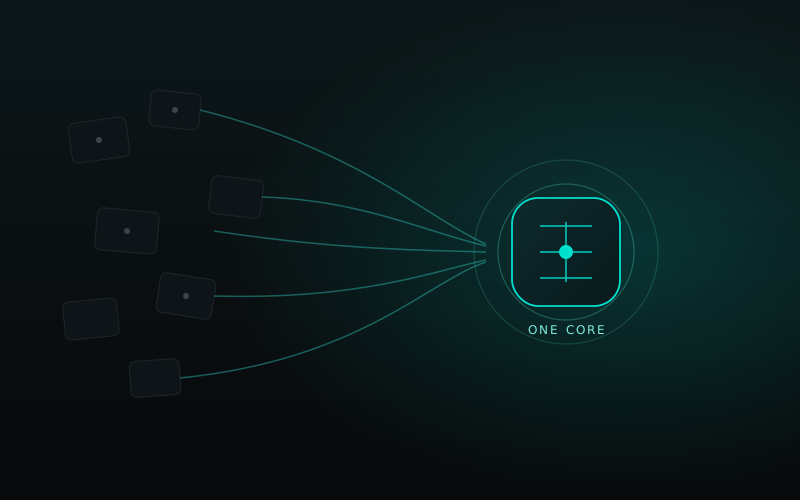
 Leonard Breitkopf