Most "AI for support" pitches are theatre: a chat widget bolted onto a help page that deflects a few FAQs and frustrates everyone else. That’s not where the value is. In a trading business, support is buried by repetitive, context-heavy work, and that is exactly the work well-built AI agents can take off the team’s plate, if they’re wired into the right data.
Beyond Chatbot Theatre
The difference between a chatbot and an agent is access and action. A chatbot answers from a script. An agent reads the trader’s actual account state, understands the question in that context, and either resolves it or hands it to a human with everything already gathered. One deflects; the other does the work. For a prop firm or broker drowning in tickets, only the second is worth deploying.
Where Agents Actually Help
The highest-value targets are the tickets that are high-volume, low-judgment, and answerable from data the firm already holds:
- 01Account & status questions ("where is my payout," "did I pass," "why was I flagged") answered instantly from live account state instead of a 24-hour ticket cycle.
- 02KYC & onboarding chasing: agents follow up on missing documents, explain rejections, and walk traders through resubmission without an operator babysitting each case.
- 03Ticket triage & routing: every incoming ticket classified, enriched with account context, and routed to the right queue or auto-resolved.
- 04Knowledge-grounded answers: rule explanations and "how do I" questions answered from the firm’s real policies, not a generic model’s guess.
Why Context Is Everything
An agent is only as useful as the context it can see. A generic LLM with no access to the trader’s account is a liability. It will confidently invent an answer. An agent wired into the operating system knows whether this trader actually passed, what rule they breached, and where their payout sits. That grounding is what turns "AI support" from a risk into a genuine reduction in workload.
"The teams that get value from AI agents aren’t the ones with the fanciest model. They’re the ones who gave the agent real context and a narrow, well-defined job. An agent that can see the account and knows when to stop and ask a human beats a clever one that guesses every time."
Milos MosovskyHead of R&D · QTG
Keeping Judgment in the Loop
The goal is not to remove operators. It’s to stop spending them on work that doesn’t need judgment. Anything involving money, disputes, or risk should route to a human with the context pre-assembled. The agent handles the volume and the gathering; the operator makes the call. Done right, the team shrinks the time spent on rote tickets and spends it on the cases that actually need a person.
How to Deploy Without Regret
Start narrow. Pick one high-volume, low-risk ticket type, ground the agent in real account data and real policies, and measure deflection and accuracy before widening scope. Keep a clean handoff to humans with full context, and make every agent action auditable. Expand category by category as trust builds. The firms that try to "AI everything" on day one are the ones that walk it back; the ones that compound wins do it one well-scoped job at a time.
AI agents reduce support workload when they’re grounded in real account context, scoped to high-volume low-judgment work, and built to hand off cleanly to humans for anything involving money or risk. Skip the chatbot theatre: deploy agents that can see the account, do the gathering, and know when to escalate.

Milos leads research and development at Quant Technology Group, including the AI models behind QuantSentry. He writes about applied AI in trading operations: where it genuinely helps, and where it’s just theatre.
More from Milos
 Leonard Breitkopf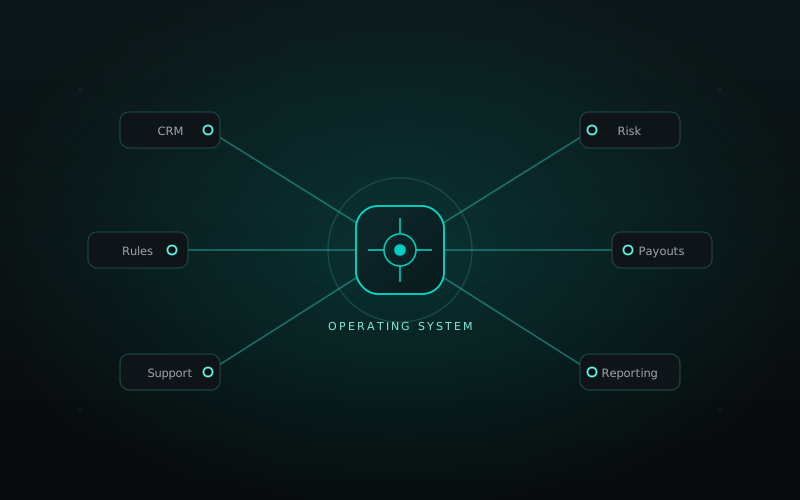
 Martin Yi
 Product · QuantSentry